Roman Numeral Analysis
in One Click
Upload any MusicXML file and Second Ear will label every chord with Roman numerals, detect key modulations, and show harmonic function — computed by MIT's music21 engine, not AI guesswork.
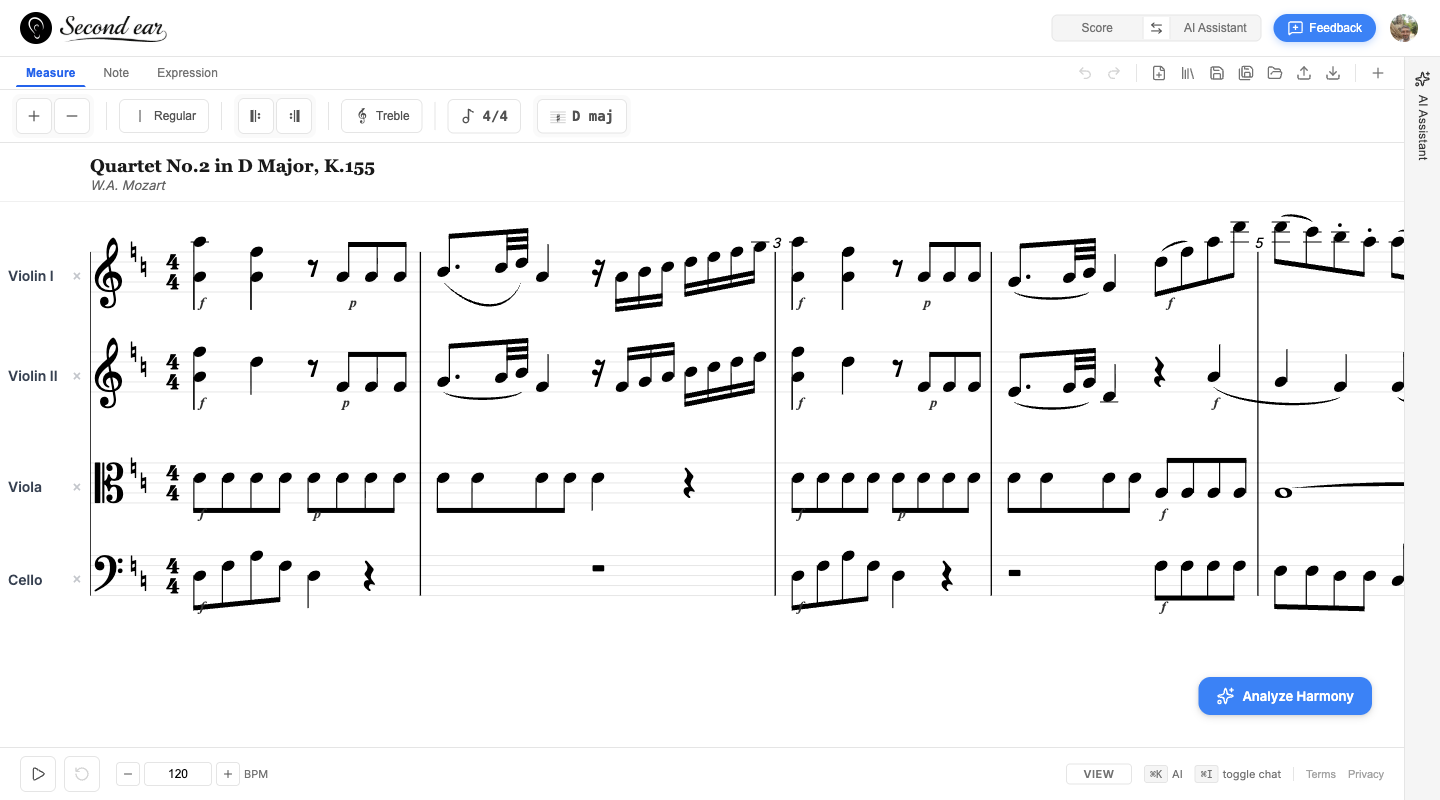
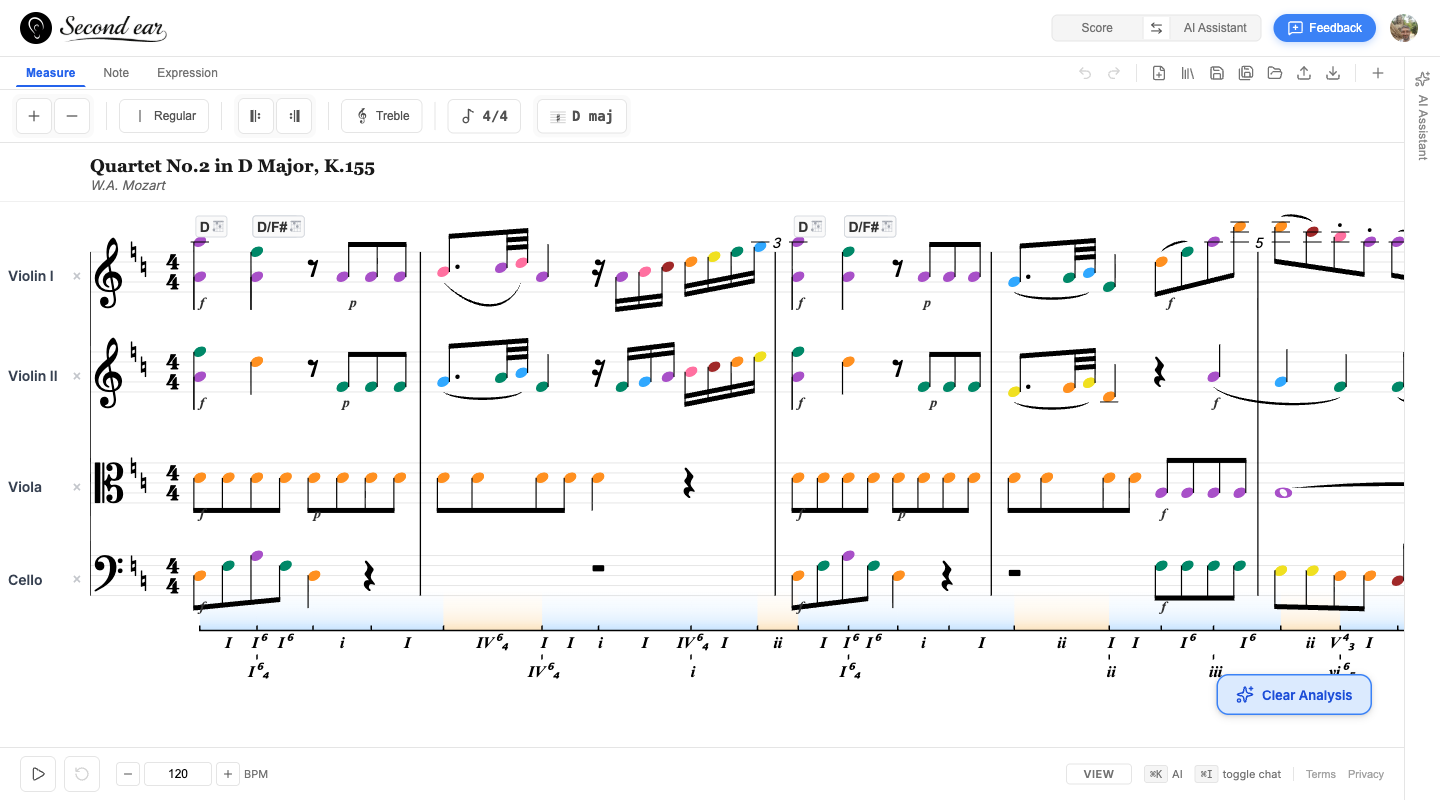
Roman numeral labels, colored noteheads, and harmonic region brackets — all computed automatically by music21.
How It Works
Three steps from score to full harmonic analysis.
Upload Your Score
Import a MusicXML file from MuseScore, Sibelius, Finale, or any notation software. You can also upload a PDF — our OMR engine converts it automatically.
Click "Analyze Harmony"
Hit the ✨ Analyze Harmony button in the toolbar. The music21 engine performs key detection and chord-by-chord Roman numeral analysis in seconds.
Read the Results
Roman numerals appear below each beat. Colored brackets show harmonic regions. Modulations are flagged with the new key. Click any chord for detailed anatomy.
What the Analysis Shows
Roman Numeral Labels
Every chord labeled with standard notation: I, ii, IV, V7, vi, vii°. Uppercase for major, lowercase for minor — exactly as your theory textbook teaches.
Key Detection & Modulations
Automatic key detection using the Krumhansl-Schmuckler algorithm. Modulations are identified and shown inline — "Key: G major → E minor".
Harmonic Regions
Colored brackets group consecutive chords within the same harmonic region (tonic, predominant, dominant), making large-scale harmonic structure visible at a glance.
Chord Anatomy Popover
Click any Roman numeral to see the full chord breakdown: root, quality, intervals, scale degrees, and a keyboard/fretboard visualization.
Understanding Roman Numeral Analysis
What is Roman numeral analysis?
Roman numeral analysis (RNA) is a music theory method for labeling chords relative to the key of a piece. Instead of absolute chord names (C major, A minor), you use Roman numerals (I, ii, IV, V) that show each chord's function within the key. A V chord is always the dominant, whether you're in C major (G) or E♭ major (B♭).
Why is harmonic analysis important?
Harmonic analysis reveals the underlying structure of music. It helps you understand why a piece sounds the way it does — why a particular chord progression creates tension, why a modulation feels surprising, or why a cadence provides resolution. It's essential for composition students, arrangers, and anyone studying music theory seriously.
How does Second Ear perform the analysis?
Second Ear uses music21, the open-source computational musicology library developed at MIT. It's the same engine used in academic research — not a language model guessing from patterns. The analysis includes key detection (Krumhansl-Schmuckler algorithm), chord identification, Roman numeral assignment, inversion detection, and modulation tracking.
What file formats are supported?
You can upload MusicXML files (.musicxml, .xml) from any notation software — MuseScore, Sibelius, Finale, Dorico, Noteflight, and more. You can also upload PDF sheet music, which is automatically converted via optical music recognition (OMR). Or simply type notes directly in the editor.
Can I ask the AI to explain the analysis?
Yes. After running the analysis, you can ask Second Ear's AI assistant questions like "Why is this chord labeled V/V?" or "Explain the modulation in measure 12." The AI reads the score directly and responds with rendered notation — it's like having a theory tutor that can see your score.
Analyze Your Score Now — It's Free
Upload a MusicXML file, click Analyze Harmony, and see every chord labeled with Roman numerals in seconds. No signup required.